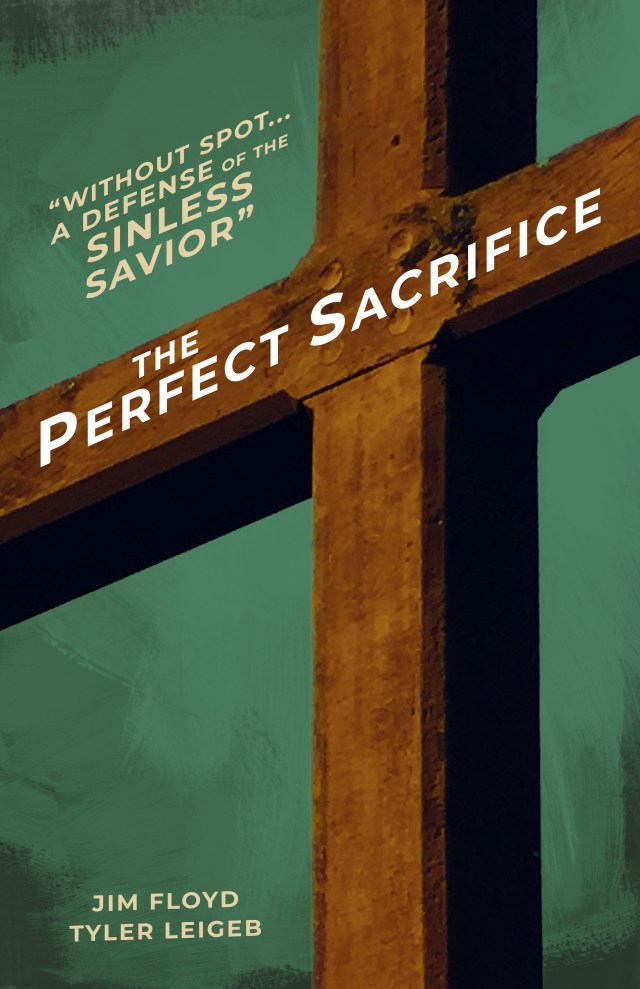
The Perfect Sacrifice

The year has come and is almost gone. I have had time for only a few posts this year, but thankfully, work on the new book I’ve been writing with my pastor, Tyler Leigeb, has been completed. We set out about a year and a half ago to address, in written form, the current teaching in some grace circles that Jesus died a spiritual death on the cross in order to atone for sin.  Needless to say, this has been a tough task for multiple reasons. The subject matter touches on many more complex passages. There are considerations to be made regarding the fact that there is disagreement on this issue.  In thinking about the miraculous virgin birth and the reality of Christ’s coming to earth, I was reminded again that He didn’t just come to be here. He came so that He could lay down the physical life that He had taken up. He did this sacrificially, innocent and without spot. That includes the fact that it was without any spiritual separation from God the Father. Thankfully, God the Father was pleased in the Son. Today, God can be pleased with you if you have been imputed Christ’s righteousness by faith based upon His shed blood, physical death, burial, and glorious resurrection.

BookCoverDesign4-c

Special thanks for this book go out to my wife, Shannon, for her help and support, and Isaac Davis for his work on the cover.  Pastor Tyler provided material and set the direction for the heart behind the book. Our goal was for friends in the ministry to look to the Word itself to see if the things we see are there. If they are, then a decision needs to be made concerning this teaching. Either JDS is Biblical, or it isn’t. I pray that people will recognize the importance of the issue.

The book can currently be purchased here in print or in pdf format.

https://www.thebookpatch.com/BookStore/the-perfect-sacrifice/61b280a2-1193-4190-aab7-edbd08fef719?isbn=9781642542004

Merry Christmas!

Jim Floyd
For additional reading, please see my previous post concerning Robert Dean’s error.

Beware of the “Jesus Died Spiritually” Heresy


Also, please take time to listen to my Pastor’s sermons: “The Cup”, “Forsaken”, and “What Satisfied the Father”

Sermon Audio

More to come.

Posted in Uncategorized | 10 Comments

Evaluating the “Romans Road”

Growing up in Baptist circles, it was common to hear talk of the “Romans Road” plan of salvation. I was taught this as a child, and many people still hold this concept of sharing Christ. Let’s examine the traditional “Romans Road” and see if it measures up as a sound way to share the good news of Jesus Christ.

The “Romans Road” starts off by telling people that they are lost.

Romans 3:23
For all have sinned, and come short of the glory of God
Romans 3:10
As it is written, There is none righteous, no, not one:

There is technically nothing wrong with this, but I would start back with Adam and Eve and explain why mankind was under the penalty of sin. Then explain how each person is responsible.

Next, the person is to be told that God, through Jesus Christ, provides the gift of eternal life. (Note that some here also include John 3:16 and don’t fully stick to the “Romans Road”.)

Rom 6:23
For the wages of sin is death; but the gift of God is eternal life through Jesus Christ our Lord.
Romans 5:8
But God commendeth his love toward us, in that, while we were yet sinners, Christ died for us

Here we see it mentioned that Christ died for us. That much is true. However, note that the Romans Road omits the cross and shed blood, as well as other aspects such as the burial and resurrection of Christ. I find this incredible given that the surrounding verses in Romans touch upon the blood, etc.

Next, the person is to confess/pray while believing in God for salvation.

Romans 10:9
That if thou shalt confess with thy mouth the Lord Jesus, and shalt believe in thine heart that God hath raised him from the dead, thou shalt be saved.
Rom 10:13
For whosoever shall call upon the name of the Lord shall be saved.

Using the two verses above is really where this falls apart. Even if you were to add I Cor 15:1-4 above, you would be presenting a false way to receive salvation here. We must understand that Romans chapters 9 through 11 are written in regard to Paul’s desire and teaching concerning the nation of Israel. Throughout, he uses the word “saved” and “salvation” to both speak of God’s wrath on Israel nationally, yet also to the spiritual salvation of the “remnant”. The remnant refers to the believers among the Israelites.

In Romans 10:13, Paul is referring to calling upon the Lord for deliverance from wrath upon the nation. Before a person can do this, however, they need to be one who believes for justification.

We must note that at this point, the person leading another down the Romans Road has options to tell the person how to receive salvation. For some, they emphasize confessing Christ as Lord, as in making Christ Lord of your life. Others take the pray and ask Jesus into your “heart” route. Some take it in the “willingness to confess and turn from sins” route. Regardless, they are taking a passage and misapplying it due to misunderstanding the thought progression and context.

Another point to consider is that the “salvation” sometimes referred to in verses like 10:13 is not talking about eternal life.

The person sharing the Romans road is then to state that the result of salvation is peace with God and safety in Jesus Christ. But think of this, is there really safety and forgiveness in Jesus Christ if a lost person 1) didn’t really know the content of the gospel and 2) really didn’t understand how to receive it by faith alone in Christ alone?

Typically, what happens is that the person witnessing shares some semblance of this with a person and then, if the unsaved person is willing, prompts the person to pray and ask Jesus to save them or pray and confess sins or pray and submit to Christ as Lord asking Him to save and help them live right. It may even be something of all of the above. I have seen all of that type of thing taught in churches throughout the years. It is all over the internet as well as far as “how” to receive Christ as Savior.

Romans 5:1
Therefore being justified by faith, we have peace with God through our Lord Jesus Christ:

Romans 8:1
There is therefore now no condemnation to them which are in Christ Jesus, who walk not after the flesh, but after the Spirit.

Romans 8:38-39
For I am persuaded, that neither death, nor life, nor angels, nor principalities, nor powers, nor things present, nor things to come,
Nor height, nor depth, nor any other creature, shall be able to separate us from the love of God, which is in Christ Jesus our Lord.

But if the person remains unsaved because you messed up sharing the gospel and sharing the method of receiving eternal life, then telling them that they are eternally secure at that point only further pushes them into falsehood. This is because the person may think they are saved when, in fact, they have either been fed a “cross-less” gospel or a faith-plus method of receiving eternal life. Either way, that is a tragedy.

Let’s, instead, as believers, tell people the truth. Let’s tell them that they are under the penalty of sin, going back to Adam. Let’s say that Jesus Christ, the Son of God, took on flesh to die as a perfect sacrifice for mankind in order to appease God’s eternal wrath on sin. Let’s tell folks how Christ lived a sinless life, died on the cross shedding His blood, was buried, and rose again for our justification. Today, He is seated in heaven, having entered the holiest of holies by way of His perfect sacrifice. He remains there always making intercession for those who will receive His blood-purchased salvation by faith.

In the comments section, feel free to share which verses you would use to share the gospel or witness to a lost person. And, at the bottom line, let’s not go down the traditional “Romans Road”.

Posted in Uncategorized | 49 Comments

Beware of Hyper-Grace: Andrew Farley and Jeremy White

Continuing our look at “Hyper grace”, let’s consider two pastors and writers who perpetuate the hyper-grace view similar to Joseph Prince. Although these individuals may not be as well-known, their teachings have influenced many believers. Andrew Farley is the writer of the book “The Naked Gospel” and Jeremy White has written the book “The Gospel Uncut: Learning to Rest in the Grace of God”. Both men espouse nearly similar views regarding this topic.

I bring these two up specifically as a warning for those who may be inclined to take their teachings.  Their message is mixed, and we should be aware of what happens when one mixes what sounds like grace with performance.

That is bad enough, but it doesn’t just stop there, because with these two, there are other doctrinal issues as well.

I have taken some telling comments from each of their two books for examination. I will give each quote, followed by my thoughts. Let’s consider Andrew Farley first.

He says, “So I John 1:9 is an invitation to become a Christian.” P 152 The Naked Gospel

(If this is your conclusion about I John 1:9, then something is off.  John was writing I John to believers, many of whom were seduced by the errors of Gnosticism. Part of that error led them to think that they no longer sinned. However, I John was written that these believers might have fullness of joy in their Christian walk. I John deals quite heavily with abiding in Christ. The tests in I John are not to determine whether a person is saved or unsaved, but whether a believer is walking in fellowship and abiding in Christ. We have to be clear that it is possible for believers not to abide. Why else tell a believer to abide? Take I John 2:6 for example: 1Jn 2:6  He that saith he abideth in him ought himself also so to walk, even as he walked. A hyper-gracer that equates abiding with salvation, then makes this verse mean that if you don’t walk as Christ walked, you are not saved. Likewise, if you hate your brother, then it would stand to reason that you are not saved. And it follows really just like calvinistic “logic” concerning I John.)

“In the Scriptures, fellowship with God is not described in this way. Instead, a person is either in fellowship with God and therefore saved, or out of fellowship and therefore lost.” P156

(This equation does not square with the rest of scripture. Be sure that fellowship does not equal salvation itself. Let’s consider Ephesians chapter 5.

Eph 5:8 For ye were sometimes darkness, but now are ye light in the Lord: walk as children of light:
Eph 5:9 (For the fruit of the Spirit is in all goodness and righteousness and truth;)
Eph 5:10 Proving what is acceptable unto the Lord.
Eph 5:11 And have no fellowship with the unfruitful works of darkness, but rather reprove them.
Eph 5:12 For it is a shame even to speak of those things which are done of them in secret.
Eph 5:13 But all things that are reproved are made manifest by the light: for whatsoever doth make manifest is light.

We are told to walk as the people we are. If we are children of light, then we should walk that way. Why is this instruction given to believers if it is automatic? Also, it goes on to say that we (as believers) should not have fellowship with unfruitful works of darkness. They are shameful and bring shame to our Savior. But the light can bring cleansing because the errors can be exposed. Also, how can a believer have ongoing practical fellowship in their Christian walk with God if they are at the same time having fellowship with unfruitful works of darkness??)

“But this is to ignore the work of Jesus, who on the cross cried out, “My God, my God, why have you forsaken me?” (Matthew 27:46). Jesus was out of fellowship with his Father so we would never be.” P 157

(Take note here that Farley is arguing that Jesus lost fellowship with the Father, but the Bible actually says no such thing. That actually amounts to what some call the Jesus Died Spiritually view, and it destroys the atonement, making Christ a sinner, not just a sacrificial spotless lamb. Forsaken, there is no indication of being abandoned in fellowship. Just like David, who first said the statement in Psalm 22, Jesus felt physically abandoned in physical pain and emotional suffering.)

“In reality, the term rewards does not appear anywhere in the New Testament. The apostle Paul speaks of a “reward” (singular, not plural) or a “prize” in the context of running a race and reaching the end.” P168

(Farley tries to excuse away the concept of rewards in heaven for believers at the Bema Seat. Why take away positive motivation to serve? Sure, we should serve out of love, but we can also do so knowing that there is eternal blessing and benefits to it.)

Speaking of Jesus: “Our new spiritual life is actually his life.” P176

(Take this and go back to abiding, or walking, or fellowship. He is saying that Christ actually lives his life through us. The Bible does not say this exactly. However, this serves as a cover for them if challenged on why a believer should walk as Christ walked if they are saved. Of course, in that case, they should walk almost perfectly. Talk about the fear and depression that can ensue once you realize you don’t walk nearly as perfectly as Jesus walked. Maybe Jesus is not walking through me? Maybe I am not saved? See the problem? We aren’t puppets for Jesus. We still have a will. Calvinism likewise makes us puppets.)

“James 2 communicates that a personal decision is necessary in order for true salvation to occur. Those who appear to fall away from belief in Jesus are those who merely associated themselves with certain doctrines for whatever reason.” P198

(This is incorrect. Yes, a person needs to decide to trust Christ, but it cannot be said scripturally that those who fall away are not saved. James 2 isn’t talking about a salvation decision. The chapter contains instructions for those who are disobedient believers.

What happened with the Hebrew believers in Heb 10? What happened to the Galatians? Why does Timothy say that the Lord remains faithful even if we do not?)

Now let’s see how Jeremy White mirrors these errors.

“It is the believing and receiving of this saving gift of grace that separates real Christianity from any other belief system in the world. It was this grace that Luther and the Reformers so passionately attempted to articulate and defend.”

White, Jeremy. The Gospel Uncut: Learning to Rest in the Grace of God. . WestBowPress. Kindle Edition.

(Luther did not understand grace as much as he should have. Just read Bondage of the Will, or better yet, spare yourself the misery and look up some quotes from it.  It is curious that he sings the praises of the Catholic Church’s reformers. Does reformed Catholicism equal grace? Didn’t they get so much wrong themselves?)

“One of the admitted weaknesses of the early “free grace” movement I referred to in the first part of this book was simply that some proponents seemed to imply that a person could claim to receive Christ by faith and then walk away from Him or even completely reject Him without ever casting doubt upon the legitimacy of their salvation. I want to be clear that I am not arguing for such a position in this book. Every believer in Jesus will bear some kind of spiritual fruit, whether it is obviously recognizable or not. On this issue I agree with the free-grace proponent Dr. Joseph Dillow, who said Those who have been born again will always give some evidence of growth in grace and spiritual interest and commitment. A man who claims he is a Christian and yet never manifests any change at all has no reason to believe he is justified.55 Another leading proponent of the free grace position with whom I agree on this point, Dr. Charles Ryrie, also affirms every Christian will bear spiritual fruit. Somewhere, sometime, somehow. Otherwise that person is not a believer. Every born-again individual will be fruitful. Not to be fruitful is to be faithless, without faith, and therefore without salvation.56″

(I bolded sections of this statement that are clearly Lordship in nature. Basically, he is saying that salvation is not by grace but by works. there can be no mistake when he says every believer in Jesus will bear some kind of fruit. Remember that a believer is justified in Christ regardless of performance. He is justified regardless of whether people can see “fruit”. Why, because it is not about fruit or performance. It is about Christ and His imputed righteousness. Hmm…not to be fruitful is to be faithless… So, if there is no fruitfulness, there is no salvation… Doesn’t that sound like the opposite of grace? I wouldn’t be surprised if that quote had come from John MacArthur or Paul Washer. Oh, but these guys aren’t like them… They are “hyper-grace”. That’s nice, but they are saying the same thing, really. Please see my posts on MacArthur and Washer.)

“If I am already totally forgiven for my past, present and future sins by the blood of Christ – then why do I need to confess my sin in order to receive forgiveness?”

White, Jeremy. The Gospel Uncut: Learning to Rest in the Grace of God. (p. 115).

(This is a classic hyper-grace false question because it confuses positional truth with practical ongoing sanctification principles right within the question itself.)

“Do you know any Bible-believing Christian who claims he or she is sinless?”

White, Jeremy. The Gospel Uncut: Learning to Rest in the Grace of God. (p. 118).

(Yes, actually, people have told me that before. One Arminian man told me that he essentially no longer sins. Ray Comfort thinks he no longer sins…)

“Becoming a Christian begins by the admission of one’s personal sinfulness and that through confession of that sinfulness, one can receive by faith the God who is faithful and just to forgive and cleanse them of all unrighteousness!”

White, Jeremy. The Gospel Uncut: Learning to Rest in the Grace of God. (p. 119).

(Is that the gospel? Are we saved by confession of sin or by grace through faith in Christ based on the gospel? Their reason is that we have to agree with God that we are sinners. Indeed, unbelievers need to recognize that they are sinners, but that is simply so that they can see their need and trust Christ for the remedy. This verse is written to believers anyway. Please see also my Faith Alone page for an extensive verse list on this.)

“1 John 1:9 is not intended to condone a one-by-one tallying of our sins so that we can confess them in order to find ongoing forgiveness or maintain “closeness” with God. When we have placed our faith in the once-for-all sacrifice of Jesus Christ, we are totally and eternally forgiven. Because of the uncut gospel of grace, we are irreversibly close to God regardless of our behavioral performance.”

(Once again, he continues with confusion as to the removal of eternal damnation and the Christian walk. If we refuse to agree with God about our sin when the Word reveals it and the Holy Spirit works through that Word, then we are resisting God’s ongoing work in us of sanctification and cleansing.)

“So how is it, then, that we imagine somehow that God the Father doesn’t remember our sins anymore, but God the Holy Spirit does – and that it is His job to keep bringing that sin to our attention?”

White, Jeremy. The Gospel Uncut: Learning to Rest in the Grace of God. (p. 123).

(Yes, as I just stated. The Word reveals the truth, and the Spirit works through the Word, bringing that truth home to us as believers. This quote is irresponsible. The Word of God is mirror of sorts.)

“It is apparent in the New Testament that the battle we face with our flesh is essentially a battle against the habits and coping mechanisms which bring us momentary pleasure or relief, apart from dependence upon Jesus.”

White, Jeremy. The Gospel Uncut: Learning to Rest in the Grace of God. (p. 163).

(This is part of White’s attempt at one-naturism. It is similar to MacArthur’s in that he attributes struggles with sin in the flesh to habits and coping mechanisms in the flesh. However, the Bible tells believers to put off the old-man and put on the new-man in their Christian walk. Now, why would believers be told to put on the new man if they are already new creatures? Hyper-grace cannot explain that. They don’t / won’t understand it.)

Conclusion

Let’s tally up the problems. (And there are more btw.) In no particular order:

1) Backdoor lordship performance requirement for salvation to be authentic. (This nullifies grace.)

2) Jesus Died Spiritually / was out of fellowship with the Father while on the cross. (This error nullifies and invalidates the object of our faith.)

3) Virtually eliminating the concept of rewards for the believer.

4) Destroying the concept of ongoing fellowship in our walk as believers

5) Adding conditions such as confession of sins to the gospel method of receiving eternal life

6) Misunderstanding Old Covenant salvation

7) Misunderstanding the Christian life (Christ lives His very life through us.)

8) A John MacArthur-style modified one-nature position. (The flesh is just old habits/coping mechanisms)

9) A confusion of practical and positional forgiveness.

10) Fellowship = salvation

There is more than enough here to recommend marking and avoiding these teachers, and don’t stand for anyone recommending them to you.

Jim Floyd

Posted in Calvinism, Heresy, Hyper grace, Lordship Salvation, Uncategorized | 69 Comments

Beware of Hyper Grace: Joseph Prince

The term “Hyper-Grace” has been thrown around, but what does this really mean? I would like you to consider today’s teachers who are currently promoting what could be called “hyper-grace.”  For those who hold this position, they may balk at this term, but suffice it to say, the term does help paint a clear picture.

I have chosen to examine three men who I have found to be preaching and teaching a similar style of error. They are Joseph Prince in part one and Andrew Farley, along with Jeremy White, in part two.

Many may be drawn to their grace like gospel talk at first glance, but one always needs to consider the fuller body of a person’s theology or work. The reason is that these men teach things further down the road that contradict their “grace” message.

So, first let’s consider some quotes from Joseph Prince. He is a preacher who can be found on TV.  Here are some telling quotes from him.

“There is no other qualification for being forgiven of your sins. The old covenant was based on justification by works (obedience to the Ten Commandments).You had to perform to be forgiven. But the new covenant of grace is based entirely on justification by faith (believing in Jesus Christ).” 
― Joseph PrinceDestined To Reign

(The first thing to notice with all three of these guys is that there is an apparent error concerning exactly how people were saved under the Old Covenant. Prince clearly states that he believes one has to perform in order to be forgiven. However, Abraham (Rom 4) was justified before God by faith alone. Then, in James 2, it is also mentioned that Abraham was justified before men by way of testimony relating to his works. But remember that his forgiveness was granted by faith.)

“Anyone who is living in sin is not under grace and has not experienced the gift of no condemnation. Grace always results in victory over sin!” 
― Joseph PrinceDestined To Reign

(Prince makes a very “lordship” work-oriented statement. It appears that he does still require performance. He has just tacked it on the backside of salvation like most lordshippers. This statement is contrary to grace. God’s grace is unmerited.)

“I don’t believe for one moment that a believer who has truly encountered the complete forgiveness of Jesus and the perfection of His finished work would desire to live a life of sin. It is His grace and forgiveness that gives you the power to overcome sin. Apostle Paul said, “Sin shall not have dominion over you, for you are not under law but under grace.”4 When you are under God’s grace and His perfect forgiveness, you will experience victory over sin.” 
― Joseph PrinceDestined To Reign

(This statement continues the previous error. Prince may be surprised to find that many of the believers (actually saved people) mentioned in the New Testament lived lives full of sin.  We will experience victory as believers, not automatically, but when we specifically walk in the Spirit, applying the truth revealed to us by God’s Word. There is a big difference.)

“Because Jesus’ blood continually cleanses you, you cannot bounce in and out of the light of Christ, in and out of being seated in the heavenly places in Christ, in and out of being forgiven, justified, and made righteous, or in and out of fellowship with God. It is not a sometimes-yes-sometimes-no salvation, but a salvation that has secured a YES to all of God’s promises because of the blood of Jesus (see 2 Corinthians 1:19-20)!” 
― Joseph PrinceGrace Revolution: Experience the Power to Live Above Defeat

(Similar to what we will see with the next two, Prince makes the mistake of equating ongoing fellowship with God with our positional place in Christ. While yes, we are saved eternally as believers, we can still find ourselves needing to deal with sin in our lives that displeases our Lord.  This is why I consider this view hyper-grace.  It extends the grace of salvation itself to practical daily living. So, to understand, on one hand they say faith will perform, but on the other, they say, well, it doesn’t matter if you mess up because you are always perfectly right with God no matter what. Though if one does too much sinning, then supposedly you are not really saved… which negates grace just as much as any lordship “doctrine”. I will say more about fellowship in part two.)

The fact is that the Bible repeatedly mentions believers whom the Lord had something against. The message in Revelation 2 to the believers at the church of Ephesus says in part: “Nevertheless I have somewhat against thee, because thou hast left thy first love. Remember therefore from whence thou art fallen, and repent, and do the first works; or else I will come unto thee quickly, and will remove thy candlestick out of his place, except thou repent.”

These believers risked the loss of their church if they did not repent (change their minds) and do the first works that were pleasing to the Lord.

Staying in chapter 2 we see a warning from the Lord to the church at Pergamos:

“But I have a few things against thee, because thou hast there them that hold the doctrine of Balaam, who taught Balac to cast a stumblingblock before the children of Israel, to eat things sacrificed unto idols, and to commit fornication.
So hast thou also them that hold the doctrine of the Nicolaitans, which thing I hate. Repent; or else I will come unto thee quickly, and will fight against them with the sword of my mouth.”

Remember that these believers were eternally saved. They were eternally as positionally righteous as Christ is righteous, but in practice, they displeased the Lord by doing things that the Lord hates. You could say the ones in danger of being fought against with the sword of His mouth were not in close fellowship with Him. They needed to repent of their errant ways and deeds.

Take a look at the rest of chapter 2 and Revelation chapter 3 and see the kind of things that believers were doing that displeased the Lord. Take note also that these churches are actual churches (bodies of believers locally assembled) from that time. Some argue that these are only types of churches throughout the ages, but that view must be read backwards into the text. So, I don’t hold to it.

Let’s also consider Hebrews chapter 10. This is written to believers. We know from the text that they were positionally sanctified. The writer of Hebrews includes himself with them and says in verse 10: “By the which will we are sanctified through the offering of the body of Jesus Christ once for all.” The writer goes on to clarify their position in Christ and challenges them to draw near with a true heart, hold fast their profession, consider one another, and to provoke others unto good works not forsaking the assembling of themselves together. Then we see a warning to the same saved people in verse 26. The willful sin was to spit in the face of God’s grace as believers and go back to law-keeping and sacrifices. God reminds us here that He will judge His people. For believers, we are referring here to physical consequences in this life and/or loss of potential rewards in the next.

2 Cor 7 is also a good reminder of believers being called out for sin. Paul had previously rebuked them and then in 2 Corinthians says to these believers beginning in verse 8: ”

“For though I made you sorry with a letter, I do not repent, though I did repent: for I perceive that the same epistle hath made you sorry, though it were but for a season. Now I rejoice, not that ye were made sorry, but that ye sorrowed to repentance: for ye were made sorry after a godly manner, that ye might receive damage by us in nothing. For godly sorrow worketh repentance to salvation not to be repented of: but the sorrow of the world worketh death. For behold this selfsame thing, that ye sorrowed after a godly sort, what carefulness it wrought in you, yea, what clearing of yourselves, yea, what indignation, yea, what fear, yea, what vehement desire, yea, what zeal, yea, what revenge! In all things ye have approved yourselves to be clear in this matter.”

Paul made them sorry with a letter. A hyper-grace advocate would not recommend doing anything to make believers feel sorry for their sins. They would say it is all under the blood, so don’t even bring it up.  But we see here that this sorrow was a good kind of “godly” sorrow. This godly sorrow is something believers can have in the Spirit. This particular “repentance” was not for eternal salvation. It was not salvation from hell, but salvation from earthly consequences and spiritual fallout, as in tarnished testimony or loss of rewards. (See other scriptures for examples.) The point is that this repentance, done by believers in response to rebuke, provided them a great clearing of themselves before the Lord in their practical walk with Him. They had been cleared in the matter. This is where a verse like 1 John 1:9 would be a parallel. To witness the continual progression of ongoing cleansing in our lives as believers, we must honestly agree with God when He confronts us. If you, as a believer, can’t admit there is a problem, then you are actively resisting the Spirit’s work in your life. You’ll still be saved, but it is tough to bear much fruit that way or be “full of joy” in your Christian experience.

Hyper grace robs people of the very concept of believers getting right with God in their personal walk with Him. I am glad that the Corinthians listened to Paul and not the advice of the likes of Joseph Prince.

In part two, we will consider quotes from Andrew Farley and Jeremy White. As always, beware of falsehood. Test everything with scripture and don’t let hyper grace suck you in.

In Christ,

Jim Floyd

Posted in Heresy, Hyper grace, Salvation | Tagged , , , , , , , , , , , , , | 39 Comments

The Gospel According to Paul or MacArthur?

John MacArthur has written a book titled The Gospel According to Paul. A friend of mine was good enough to send me a copy and so I have examined it and found 12 telling quotes from the book. The premise appears to be an attempt to find out what gospel Paul shared and to some degree MacArthur does discuss the content of the message of 1 Cor 15 however in many ways he undoes the truth revealed through adding in his own theological reformed leaning bent. Doing so muddies and even changes the gospel.

12 telling quotes:

p xxii “Two of my best-known books on the gospel are in-depth critiques of the preposterous notion that repentance, self-denial, the cost of discipleship, and the lordship of Christ are all truths unnecessary for salvation and thus best left out of our gospel proclamation.”

(Here MacArthur admits that he thinks that salvation is not received by what I would call faith alone. No place does the Bible state that things such as self-denial, commitments to discipleship, or submission to Christ’s lordship are required for reception of eternal life.)

p xxvii “Some influential voices in the evangelical movement today still teach that obedience to Christ is an optional and unnecessary adjunct to “accepting Him” as Savior. Some still would deny that the gospel calls sinners to repentance or instructs them to follow Christ.”

(The gospel instructs them to follow Christ? No the gospel is the good news that Christ died for us, was buried, and rose again. We must obey the gospel. How? By believing it as true. That is what it means to trust Christ as Savior. It is placing our faith in Him to save. Remember for MacArthur repentance does not mean to change one’s mind but to turn from sin.)

P 14 “So how could God ever justify the ungodly without compromising His own righteousness? The answer is that Christ willingly died in place of those whom He saves. He is their Substitutue…”

(This is couched in verbiage of one who holds to a limited view of the atonement. Many Calvinists believe that Christ only died for the elect and not the whole world.)

p 22 “…Christ died for our sins according to the Scriptures… He was buried … He rose again the third day according to the Scriptures, and … He was seen.” That is the whole gospel. The rest is explanation.”

(Right, but how should one explain it? As in yeah, that is the good news but oh by the way Christ only died for the few chosen ones? Is that really good news to anyone? It is not really even good news to any supposed pre-chosen ones because even in the end of the day you cannot, like MacArthur, even know 100 percent that you are one of the chosen ones because in this system one must persevere to the end. There is always in that system the chance of failure. Plus this says nothing about counting the cost of discipleship or turning from sins. So where does that enter the explanation?)

p 23 “So many people spurn the good news because they can’t get past the starting point, which requires us to confess our sin.”

(No, that is a false gospel. The reason so many reject the gospel, just as the Pharisees did, is that they can’t in their humans minds and pride accept something by grace that is undeserved and unearned. I am convinced that the easiest lie for the devil to sell is that one needs to do something to help earn salvation.)

p 24 “… all false religions are systems of human achievement.”

(How ironic because reformed theology and Calvinism fit this statement. They are works oriented systems masquerading as grace. In the end once the varnish is stripped off, it is just as much works oriented as any other religious system. It is as much works for salvation as even the Catholicism from which it came.)

p 54 “This righteousness is imputed (credited to the account of) to every sinner who renounces sin and trusts Christ as Savior.”

(Once again MacArthur fails to understand the means of the prescribed method of receiving the gift of eternal life by faith. And in doing so he begins to directly contradict his own context.)

p 92-93 double-talk, Spurgeon “That God predestines, and yet that man is responsible, are two facts that few can see clearly. They are believed to be inconsistent and contradictory to each other….”

(MacArthur apparently felt that he needed to quote some of Spurgeon’s philosophy and double speak concerning election. To be clear here God does not in any way pre-select who will believe. He predestines that those that do believe will be adopted as sons and receive the inheritance. Eph 1:5, 13)

p 104 “God’s grace is the originating cause of regeneration; the sinner’s faith is the immediate effect.”

(The obvious problem is that the scripture itself does not say this. Regeneration can in no way precede the first time a person believes the gospel. Regeneration follows reception of the free gift through faith. Paul made this quite clear. So it is misleading for MacArthur to suggest otherwise.)

p 104-105 “If the sinner’s own free-will choice rather than God’s electing grace were the determining factor in salvation, no one would ever be saved.”

(This is also false. MacArthur is assuming no one would choose to believe but remember for MacArthur the idea of faith includes any number of things such as turning from sins, making Christ the Lord of your life, commitments to discipleship etc. And apparently he has forgotten that the gospel itself is the power of God unto salvation. The gospel is the light that the Holy Spirit uses to illuminate the blinded. 2 Cor 4 mentions that the god of this world has blinded the minds of the lost. This is something the devil has done, not God. Men may choose to continue to believe any lie or may repent (change their mind) and receive salvation based on the specific revelation of the truth. They already have God’s general revelation to know they are without excuse. Rom 1. The fact is that if our gospel is hid, even such as in MacArthur’s loaded lordship version, it is hid to those who are lost and already blinded by the devil. What a shame. So many like MacArthur appear to desire that people live Christian lives but the way to get there is not to front or back load the gospel with works or extra qualifications that are meant for ongoing obedience in the Christian walk in sanctification.)

p 105 “Again, every aspect of salvation – beginning with regeneration, including the sinner’s faith and good works – all of it – is purely by grace. It is done for us freely.

(No it is not done for us. Christ paid the penalty of sin for us. we must receive it by faith. Otherwise the gift goes unappropriated. It is there for any who will receive it and all may receive it.)

P 107 “Faith adds nothing meritorious to salvation; it is simply the channel through which the blessing is received. But some measure of practical righteousness is the inevitable fruit of saving faith.”

(Here is an illustration how some like MacArthur begin to have the right idea on paper yet mess it up by adding in that last line about “inevitable” fruit. Practical righteousness is not inevitable otherwise, as I have said before, the New Testament could have been much shorter without having to have so much instruction about how to live the Christian life.  You could take out all of the rebukes to the Galatians, Romans, Corinthians, Hebrews, the believers that James wrote to  and on and on.

Remember the Reformed concept of “faith” is that it is a gift from God and that it must behave and perform as a certain special kind that is only available to a few pre-selected chosen few. Good works then become vital to even begin to know if one is truly saved. However the Bible states that we can know our standing based on whom we have believed. Our salvation is a sure a Christ is God and the gospel is true. Works have nothing to do with it because our salvation was not by works of the law but was offered by grace because Christ did the work. Reformed theology goes far beyond this making puppets out of men and making an ogre out of God. God in that system is change from the one Paul describes to a God that pre-chooses most people to have no chance but to damned eternally.  Please do not let people like MacArthur fool people into thinking Paul taught any such thing.)

In summary we can see that MacArthur has not really explained what Paul said very well but instead has taken the opportunity to try to inject Calvinism and Reformed style theology back into various texts. In doing so he actually created some paradoxes and made what should be straight forward, confusing. Let’s not confuse people as to what the gospel is or how people can receive it.

Posted in Calvinism, Lordship Salvation, Reformed Theology | 15 Comments

Introducing the James 2 Explained page

Greetings all,

For your consideration i have added as stand alone page that explains my view of James 2. I pray that it is a benefit to all.

Any comments for it can be added here as I will not allow comment on the page itself.

In Christ

Jim Floyd

James 2 Explained

Posted in Free Grace, Uncategorized | 16 Comments